Start with the temperature your process actually needs, the temperature of the available heat source, and the hours when heat is required. By the end, you can screen suitable applications, calculate the real design load, compare technologies on delivered heat cost, and identify when a heat pump needs a booster, backup system, or process redesign.
Key takeaways
- Map supply, return, setpoint, operating hours and contamination controls.
- Use 60°C as an initial screening boundary, not a guaranteed process temperature.
- Measure peak heat load and confirm a usable, stable heat source.
- Compare systems using actual leaving-water temperatures and design conditions.
Map the process temperature before choosing the heat source
Start with the process setpoint, not the label “high-temperature heat pump.” Build a process-temperature map showing the required supply temperature, return temperature, operating hours and contamination controls; a 60°C supply cannot heat a 60°C process through an exchanger with no temperature difference.
| Temperature | Typical fit | Heat-pump implication |
|---|---|---|
| 40°C | Equipment wash-down, low-temperature wash water, aquaculture and some fermentation duties | A standard hot-water heat pump often fits if the return temperature remains high enough for efficient recovery. |
| 60°C | General wash water, laundry prewash, low-temperature cleaning-in-place and space-process heating | A 60°C system fits when the exchanger and process setpoint stay below its usable leaving-water limit. |
| 70°C | Food and beverage cleaning stages, plating tanks and pasteurisation preheating | Specify the actual load; a cascade or booster heater may cover the final lift. |
| 80°C | Higher-temperature cleaning-in-place, laundry finishing and drying-air coils | Investigate a high-temperature unit, especially with warm wastewater, condensate or cooling-water recovery. |
| 90°C or more | Pasteurisation hot-water circuits, demanding drying and high-temperature manufacturing baths | Use a certified high-temperature heat pump, cascade, booster, boiler or another heat source when the process needs rapid heating, steam, direct contact or temperatures above the equipment limit. |
The return temperature reveals how much heat the process actually removes. A stable base load below about 90°C is a strong candidate; a batch needing sudden heat or combustion-like temperatures points toward hybrid equipment rather than heat-pump-only operation.
Use the 60°C boundary to screen suitable applications
A 60°C hot-water system fits when the process-side heat exchanger can deliver the required setpoint with a useful temperature difference. Wash-water heating, laundry heating, cleaning-in-place and pasteurisation preheating often fit, provided the process needs 60°C or less rather than merely returning water at that temperature.
1. Record the actual process setpoint, supply temperature, return temperature and heating time. A 60°C supply cannot reliably heat a process requiring 60°C at the exchanger outlet; allow a temperature difference for heat transfer, pipe losses and control.
2. Check contamination control before choosing direct heating. Use an indirect stainless-steel heat exchanger for food, beverage or potable-water duties, and specify separation, cleanability and leak detection where one fluid must not contaminate the other.
3. Choose a cascade or booster heater when the main load sits below 60°C but a smaller final stage needs 70°C or more. This suits pasteurisation finishing, high-temperature rinse stages and occasional peak demand better than sizing the entire heat pump for the highest setpoint.
4. Redesign the heat exchanger when the existing coil cannot transfer enough heat at a 60°C primary supply. A larger surface area, higher flow or lower process return temperature can remove the bottleneck.
Direct-contact heating, rapid batch heating, high-pressure steam, thermal-fluid circulation and any duty above the equipment’s certified leaving-water temperature need a boiler, electric heater, different heat source or hybrid arrangement. Use the heat pump upstream for preheating when it cannot safely provide the final temperature.
Measure the heat load and the available heat source
Start with measured flow, temperatures and operating hours rather than the equipment’s rated output. Calculate process heat from mass flow × specific heat × temperature rise, then add pipe, tank and building losses. Record the hourly heat load across production shifts, cleaning cycles and idle periods.
- Build an hourly profile for a representative production year. Mark the seasonal heat load, including winter source temperatures, summer cooling demand and planned shutdowns.
- Separate steady base demand from batch peaks. Record each batch size, starting temperature, target temperature and warm-up time; a short, high-power demand can exceed the heat pump’s capacity even when daily energy use looks modest.
- Log the heat source at the same intervals: inlet temperature, available flow, operating hours, fouling, contamination and interruptions. Include refrigeration discharge, wastewater, condensate, cooling water or ambient air conditions.
A viable design has enough source energy at the required temperature during every critical hour, not just a favourable test period.
Compare the source profile with the heat pump’s actual capacity and power at the intended source and leaving-water temperatures; request data under EN 14511 test points and EN 14825 part-load conditions, including defrost and auxiliary power.
A stable base load suits continuous heat-pump operation, while a buffer tank, boiler or electric heater can cover batch peaks and rapid warm-up. If the source repeatedly falls below its usable temperature or flow, size backup capacity or reject the application.
Compare technologies using real leaving-water conditions
Investigate a high-temperature heat pump first when a stable source such as 30–60°C cooling water, condensate, warm wastewater or refrigeration discharge can serve a sustained load, and the required leaving-water temperature is within the unit’s certified range.
Compare the temperature lift and COP at required leaving-water temperature, not the label “high temperature”: lifting 50°C water to 80°C can outperform lifting 10°C air to 60°C.
| Option | Compare the real leaving-water duty | When a heat pump is the better investigation |
|---|---|---|
| High-temperature heat pump | Check 80–150°C leaving water, source temperature, flow rate and COP at required leaving-water temperature | Sustained demand exists and recovered heat is available; verify ratings under EN 14511 and seasonal or part-load results under EN 14825 |
| Gas or oil boiler | Supplies high temperatures and steam quickly, but pays for combustion and flue losses | Choose it first for direct flame, high-pressure steam, rapid batch heating or temperatures above the heat pump’s certified limit |
| Resistance heater | Converts electricity directly at roughly one unit of heat per unit of electricity | Use for small, intermittent loads or backup; investigate a heat pump for long operating hours |
| Steam or thermal-oil heater | Matches established distribution and high-temperature process equipment | Retain it for direct steam contact, very high temperatures or fast batch response; use a heat pump for preheating |
| Waste-heat recovery | Uses heat directly when its temperature matches the process | Choose it when direct recovery reaches the leaving-water target; add a heat pump when recovery is too cool |
A boiler, steam system or thermal-oil heater can remain the final-temperature stage while the heat pump preheats the return water. Compare electricity price divided by COP with fuel price divided by useful boiler efficiency, including demand charges, backup capacity and annual running hours.
Turn a promising application into a safe equipment specification
Order only after the supplier converts your process map into guaranteed operating points, not a single headline COP. For plating tanks, drying and low-temperature manufacturing, specify process setpoint, supply and return temperatures, hourly load, peak load, acceptable ramp time and required availability.
- Request capacity, input power and COP at your actual source and sink temperatures under EN 14511 test points. Ask for EN 14825 part-load and seasonal data, including pumps, fans, controls and defrost energy; mild-weather air-source figures can overstate cold-climate output.
- Define contamination control in writing. Require a separate heat exchanger, compatible materials, leak detection and a cleanable circuit when process fluid cannot contact refrigerant-side water. State the consequences of a failed exchanger.
- Record refrigerant type, charge, safety classification, service providers and future availability. Check F-gas restrictions where the equipment will operate, then verify compressor discharge temperature, seals and heat-exchanger ratings at the specified lift.
- Measure site conditions: source-temperature stability, outdoor design temperature, airflow, electrical capacity, water quality, drainage for condensate and defrost, noise limits and space for maintenance.
- Specify controls for steady base load, buffer-tank operation, setpoint limits, alarms, remote logging and automatic defrost. State whether a boiler or electric heater covers start-up, peaks and heat-pump failure.
- Make every claim testable: obtain a signed performance schedule, exclusions, warranty response times and acceptance test. Adreco Engineering Pvt Ltd should be asked for the same process-specific evidence before its equipment enters your comparison.
Related product
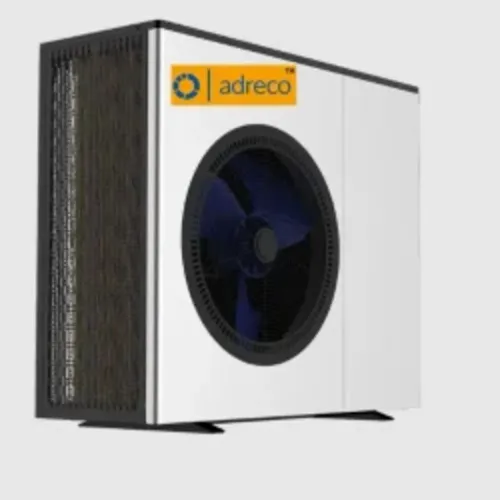
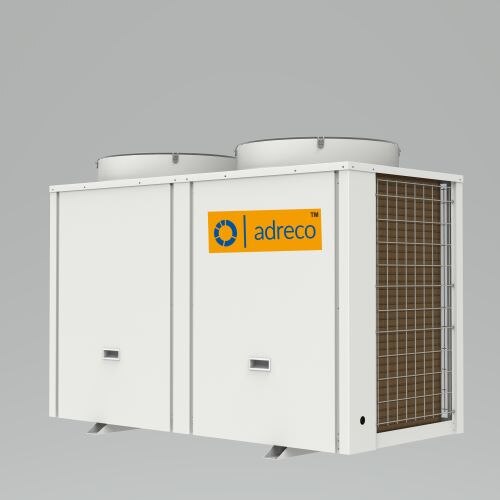 | EVI Heat Pump ₹195000 features: 1. Operating ambient temperature range up to -30° C to 43° C. 2. Hot water temperature upto 60° C. 3. View product → |
Frequently asked questions
What process temperatures should you map before choosing a heat pump?
Record the process setpoint, required supply temperature, return temperature, operating hours and contamination controls. Include the temperature difference needed across the heat exchanger.
Why is 60°C a useful screening boundary?
A 60°C supply cannot heat a 60°C process through an exchanger because heat transfer requires a temperature difference. Treat 60°C as an initial screen, then confirm the actual supply temperature the process needs.
What measurements are needed to assess a high-temperature heat pump application?
Measure the heat load, flow rate, supply and return temperatures, operating schedule and available heat-source temperature. Check whether the source remains usable during peak demand.
How should you compare high-temperature heat pump technologies?
Compare them at the actual leaving-water temperature, source temperature and design load. Do not rely on a headline maximum temperature that does not match your operating conditions.