


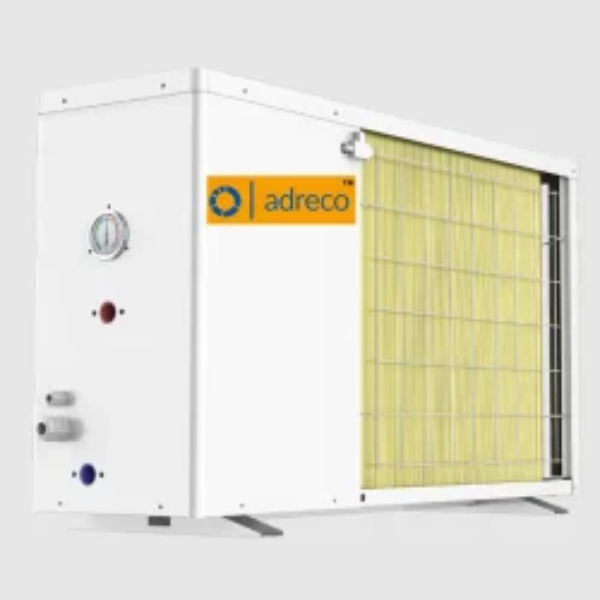
Hot water is a recurring household energy requirement. Bathrooms, kitchens, utility areas, and other domestic activities can create significant daily demand, particularly in larger homes and multi-family residential properties. Domestic Heat Pumps offer an alternative approach by transferring heat from ambient air into water rather than relying entirely on direct electrical heating.
For homeowners in Chandigarh, understanding this technology can make it easier to evaluate long-term residential hot-water options.
What Domestic Heat Pumps Actually Do
A domestic heat pump uses a refrigeration cycle similar in principle to technology found in air-conditioning systems, although its purpose is to move heat into water.
Ambient air passes across an evaporator containing refrigerant. The refrigerant absorbs heat, which is then increased in temperature through compression. A heat exchanger transfers this thermal energy into the water circuit.
The heated water can subsequently be stored in an appropriately sized tank for household use.
Why Storage Capacity Matters
Households rarely consume hot water at a perfectly constant rate.
Morning bathing routines may create a large short-term demand, while usage during other parts of the day may be considerably lower. This is why storage-tank sizing is an important part of a residential heat pump installation.
Planning should consider:
- Number of occupants
- Number of bathrooms
- Typical shower usage
- Required water temperature
- Simultaneous hot-water demand
- Daily consumption pattern
- Available installation space
An appropriately sized system should address both heat-pump recovery capacity and stored hot-water availability.
Energy Efficiency Depends on Real Usage
The appeal of Domestic Heat Pumps comes from their ability to move available environmental heat. However, actual energy consumption depends on operating conditions.
Setting water temperatures substantially higher than necessary may increase energy requirements. Poorly insulated storage tanks or long uninsulated hot-water pipes can also waste heat after it has already been produced.
Efficient operation therefore involves both equipment selection and reducing losses throughout the hot-water system.
Installation Location Deserves Attention
Air-source equipment needs adequate access to ambient air. Restricting airflow around the unit can affect its ability to absorb heat effectively.
Installation planning should consider ventilation, drainage, maintenance access, noise, piping distance, electrical requirements, and the manufacturer's specified clearances.
Homeowners should avoid treating the equipment as an appliance that can simply be placed in any enclosed corner.
Chandigarh Homes Face Seasonal Variation
Residential heating requirements in Chandigarh change considerably throughout the year. Incoming water temperature and ambient conditions can both influence the energy required to produce usable hot water.
A system selected only according to summer conditions may not adequately represent winter requirements.
Homeowners evaluating a heat pump should therefore discuss seasonal ambient temperatures, desired hot-water availability, peak consumption, and recovery expectations with the system provider.
Good Controls Prevent Unnecessary Operation
Modern heating controls can help coordinate water temperature and operating schedules with household requirements.
For example, a household with predictable hot-water demand may not need identical heating operation throughout every hour of the day. Appropriate controls and storage can help align heat production with expected consumption.
However, temperature settings and storage practices should also follow applicable hygiene and system-design requirements.
Look at the Complete Residential System
Adreco Engineering Pvt Ltd manufactures heat pump and HVAC solutions for different heating applications. In a domestic project, meaningful equipment selection begins with household demand rather than simply choosing a unit from a capacity list.
A homeowner should consider the heat pump, storage tank, circulation system, plumbing layout, insulation, controls, and available installation space as parts of one system.
Properly selected Domestic Heat Pumps can provide an efficient approach to residential water heating, particularly when the equipment is correctly sized and the rest of the installation is designed to minimise unnecessary thermal loss.


